

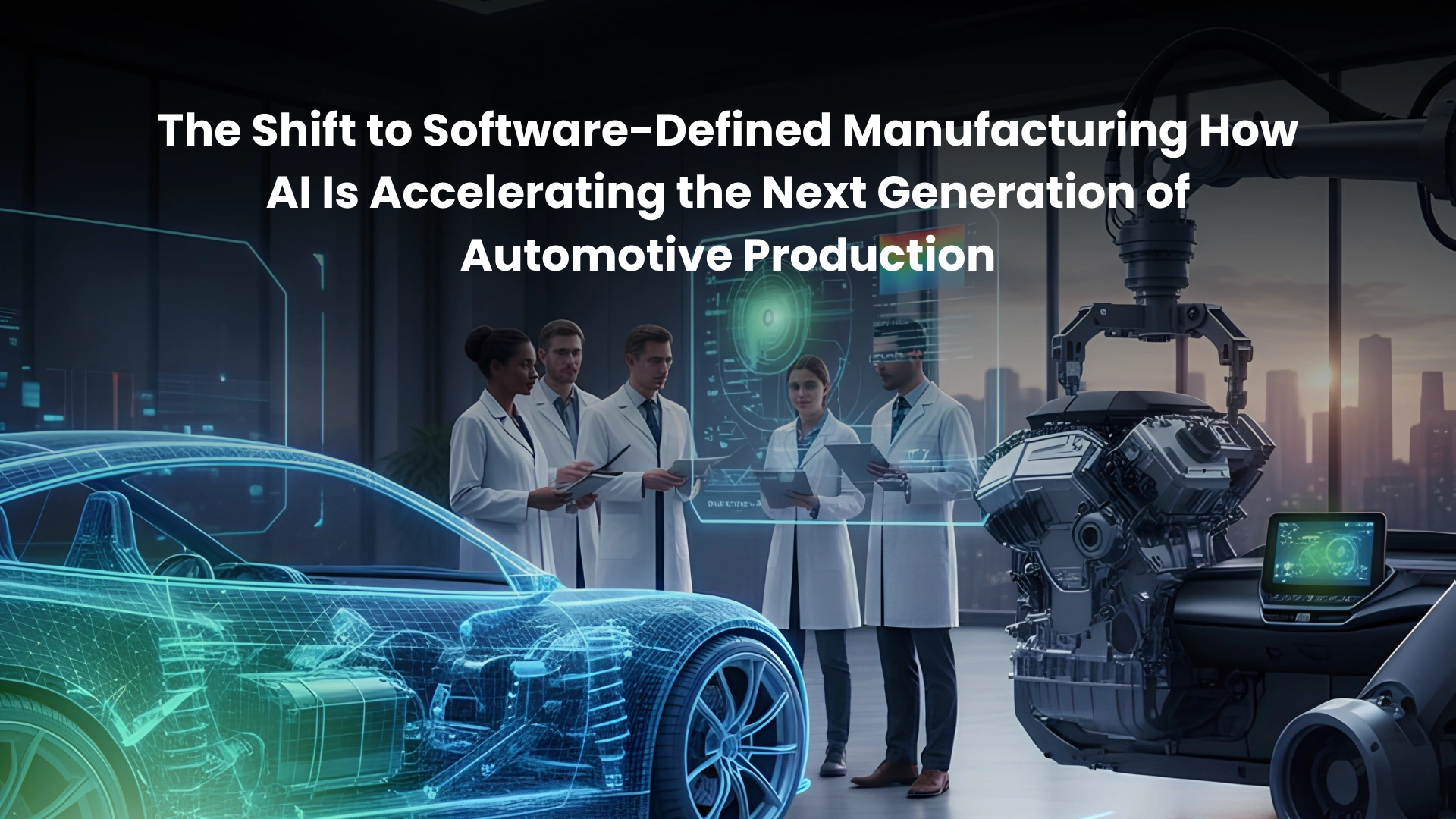

The automotive industry is entering a new era where competitive advantage is no longer determined solely by production capacity or engineering excellence. Instead, manufacturers are increasingly differentiating themselves through intelligent software, connected production systems, and AI-driven factory operations.
This transformation is giving rise to Software-Defined Manufacturing (SDM)—an approach that applies software, artificial intelligence, cloud computing, and real-time data to make production lines more adaptive, autonomous, and efficient.
As automakers invest in electric vehicles (EVs), Software-Defined Vehicles (SDVs), and increasingly complex supply chains, traditional manufacturing models are proving too rigid to keep pace. Software-defined manufacturing enables factories to respond dynamically to demand fluctuations, production issues, and design updates without relying on lengthy manual interventions.
For automotive manufacturers, the factory itself is becoming as intelligent as the vehicles it produces.
Why Traditional Manufacturing Is Reaching Its Limits
Automotive production has always been optimized for consistency and scale. However, today’s manufacturing environment presents new challenges:
- Increasing EV production complexity
- Frequent software updates for vehicles
- Global supply chain disruptions
- Rising labor shortages
- Shorter product development cycles
- Growing demand for customization
Conventional production systems often struggle to adapt quickly when market conditions change.
Software-defined manufacturing addresses this challenge by replacing static production processes with intelligent, data-driven operations that continuously optimize themselves.
What Is Software-Defined Manufacturing?
Software-defined manufacturing separates production intelligence from physical machinery.
Instead of relying solely on fixed automation, factories increasingly use centralized software platforms that monitor, coordinate, and optimize production across every stage of manufacturing.
This enables manufacturers to:
- Update production workflows through software
- Reconfigure assembly lines faster
- Optimize machine utilization
- Improve quality inspection
- Predict maintenance requirements
- Monitor factory performance in real time
- Scale production with greater flexibility
Rather than treating manufacturing equipment as isolated assets, software connects the entire production ecosystem.
AI Is Becoming the Factory’s Operational Brain
Artificial Intelligence is enabling factories to make faster and more informed operational decisions.
Modern AI platforms continuously analyze data from:
- Industrial sensors
- Robotics systems
- Machine vision cameras
- Production equipment
- Warehouse operations
- Energy management systems
- Quality control stations
Using this information, AI can:
- Detect production anomalies
- Predict equipment failures
- Balance production workloads
- Optimize assembly sequencing
- Improve inventory planning
- Reduce production downtime
Instead of responding to problems after they occur, manufacturers increasingly prevent disruptions before they affect production.
Digital Twins Are Changing Production Planning
One of the most significant technologies supporting software-defined manufacturing is the digital twin.
A digital twin creates a virtual representation of production lines, machines, and manufacturing processes.
This allows manufacturers to:
- Simulate new production workflows
- Test factory changes before implementation
- Predict equipment performance
- Evaluate production bottlenecks
- Optimize factory layouts
By validating decisions in virtual environments, organizations reduce implementation risks while accelerating innovation.
Machine Vision Is Improving Quality Control
Traditional quality inspections often rely on manual sampling or predefined automation rules.
AI-powered machine vision enables continuous inspection throughout the manufacturing process.
These systems can identify:
- Surface defects
- Component alignment issues
- Assembly inconsistencies
- Paint imperfections
- Welding defects
- Missing parts
Because inspections occur in real time, manufacturers can resolve quality issues before defective vehicles progress through production.
This improves customer satisfaction while reducing warranty costs.
Edge Computing Is Enabling Real-Time Factory Intelligence
Manufacturing environments generate enormous amounts of operational data every second.
Sending all data to the cloud for analysis can introduce latency.
Edge computing allows AI models to process information directly within manufacturing facilities.
Benefits include:
- Faster decision-making
- Lower network latency
- Improved production reliability
- Reduced bandwidth usage
- Greater operational resilience
For automotive production, where milliseconds can influence manufacturing precision, edge intelligence is becoming increasingly valuable.
Software Is Reshaping Supply Chain Visibility
Production efficiency depends on supply chain coordination.
AI-powered manufacturing platforms now integrate supplier, logistics, and production data to provide end-to-end visibility.
Manufacturers can:
- Predict component shortages
- Monitor supplier performance
- Optimize inventory levels
- Forecast production delays
- Recommend alternative sourcing options
This level of intelligence helps organizations respond more quickly to global supply chain disruptions.
Sustainability Is Becoming Part of Manufacturing Intelligence
Environmental performance is becoming a core manufacturing metric alongside productivity and quality.
AI helps optimize sustainability by reducing:
- Energy consumption
- Material waste
- Water usage
- Equipment idle time
- Carbon emissions
Smart factories increasingly monitor environmental performance in real time, supporting both operational efficiency and corporate sustainability goals.
Cybersecurity Is Now a Manufacturing Priority
As factories become more connected, cybersecurity risks continue to increase.
Software-defined manufacturing environments require protection across:
- Industrial control systems
- Connected robots
- IoT devices
- Production networks
- Cloud platforms
- Operational technology (OT)
Manufacturers are adopting Zero Trust architectures, AI-powered threat detection, and continuous monitoring to protect production systems from cyber threats.
Securing factory software is becoming just as important as maintaining physical equipment.
The Future Factory Will Continuously Learn
Software-defined manufacturing is evolving beyond automation toward autonomous production systems.
Future AI-powered factories are expected to:
- Self-optimize production schedules
- Automatically adjust workflows
- Coordinate autonomous mobile robots
- Predict maintenance months in advance
- Generate real-time production insights
- Adapt assembly processes for new vehicle models
- Support human workers with AI assistants
Instead of relying on static production rules, factories will continuously improve based on operational data.
Why Software-Defined Manufacturing Is Becoming an Industry Imperative
The automotive industry is no longer defined only by the vehicles it builds but also by the intelligence of the factories behind them.
Software-defined manufacturing enables automakers to increase production flexibility, improve quality, strengthen supply chain resilience, and accelerate innovation without proportionally increasing operational costs.
As electric vehicles, autonomous driving technologies, and software-defined vehicles become mainstream, manufacturers will need production systems capable of evolving just as rapidly as the products themselves.
For automotive leaders, the next competitive advantage won’t come solely from faster assembly lines—it will come from factories that can learn, adapt, and optimize themselves through AI, transforming manufacturing into a continuously improving digital ecosystem.