
Table of Contents
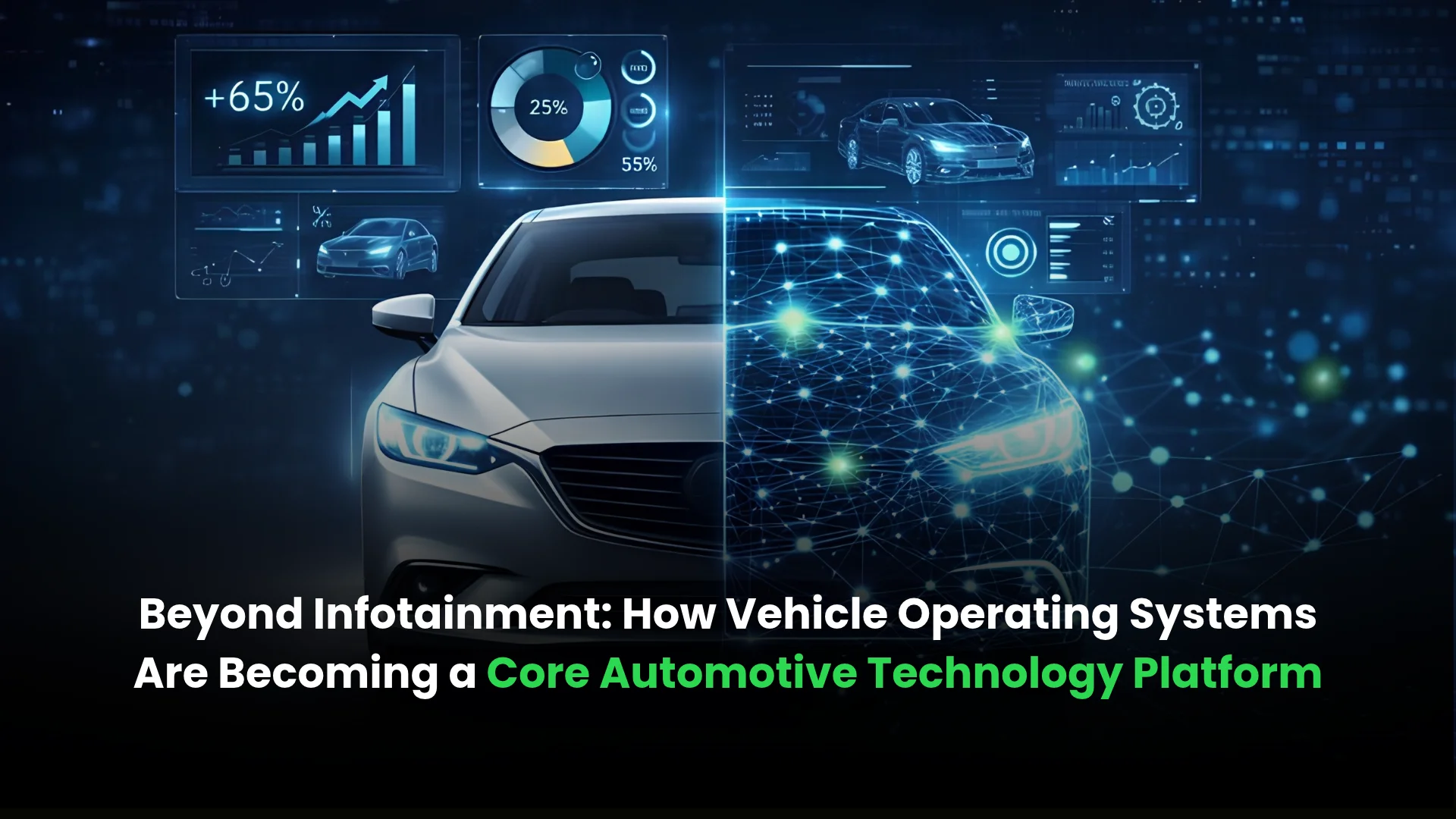
The modern vehicle is evolving from a collection of independently controlled electronic systems into a connected computing platform. Features such as digital instrument clusters, touchscreen infotainment, driver assistance, connected navigation, over-the-air updates, and vehicle diagnostics increasingly depend on software working across multiple electronic components.
At the centre of this transformation is the vehicle operating system (Vehicle OS). What was once largely associated with powering infotainment screens is becoming a broader technology layer that supports communication between vehicle functions, manages computing resources, and enables software-driven features throughout the vehicle.
As automakers invest in software-defined vehicles, the operating system is becoming an important part of automotive architecture, influencing how vehicles are developed, updated, secured, and maintained over their lifecycles.
What Is a Vehicle Operating System?
A vehicle operating system is the software foundation that manages computing resources and enables applications and vehicle functions to operate on automotive electronic hardware.
It provides services that allow software components to communicate with processors, sensors, displays, networks, and other electronic control systems.
Unlike a traditional consumer operating system, automotive software must support different safety, reliability, timing, and security requirements. A vehicle may need to run entertainment applications while also supporting functions that require predictable and carefully controlled responses.
Depending on the vehicle architecture, the software environment may include:
- Automotive operating systems: Software platforms that manage hardware resources and support applications.
- Real-time operating systems (RTOS): Systems designed to execute tasks within defined timing constraints.
- Automotive middleware: Software that enables communication between applications and electronic control units.
- Hypervisors: Technology that allows multiple operating system environments to run on shared hardware with isolation.
- Application frameworks: Development environments for vehicle features and connected services.
These components work together, although not every vehicle uses the same architecture or a single unified operating system.
1. Moving Beyond Infotainment Systems
Early automotive software platforms were often focused on specific functions, such as navigation, audio, connectivity, and touchscreen interfaces.
Modern vehicles require a much broader range of software capabilities. Digital cockpits, advanced driver assistance systems (ADAS), vehicle diagnostics, energy management, and connected services are increasingly part of the same software ecosystem.
This shift is changing the role of vehicle operating systems.
| Traditional infotainment-focused approach | Broader vehicle software platform |
|---|---|
| Manages entertainment and navigation interfaces | Supports multiple vehicle software domains |
| Operates mainly around the dashboard experience | Connects cockpit, connectivity, and selected vehicle functions |
| Updates are often feature-specific | Supports coordinated software lifecycle management |
| Limited interaction with other vehicle systems | Enables controlled communication across vehicle domains |
| Primarily focused on user experience | Balances user experience, performance, safety, and security |
The transition does not mean that every vehicle function is being moved into one operating system. Safety-critical controls may continue to run on dedicated electronic control units and real-time software environments.
The broader change is the development of a more integrated architecture in which software platforms coordinate different computing environments.
2. The Rise of Software-Defined Vehicles
Software-defined vehicles (SDVs) are designed so that a significant portion of vehicle functionality can be developed, configured, improved, or extended through software.
In conventional vehicle development, many features are closely tied to specific hardware components. Updating a function can require changes to individual electronic control units, wiring, or hardware configurations.
A software-defined approach aims to create more flexible vehicle architectures, where hardware platforms and software capabilities can evolve more independently.
Vehicle operating systems support this transition by providing common software services and development environments.
For automakers, this can create opportunities to:
- Introduce new digital features after vehicle delivery.
- Improve selected vehicle functions through software updates.
- Standardize software development across vehicle models.
- Reuse applications and software components across platforms.
- Reduce duplication between different vehicle programs.
However, software-defined architecture requires careful coordination between hardware suppliers, software teams, vehicle engineering, and cybersecurity specialists.
3. Centralized and Zonal Architectures Are Changing Vehicle Computing
One of the major developments in automotive engineering is the shift from highly distributed electronic control units toward more centralized and zonal computing architectures.
Traditional vehicles can contain numerous ECUs, each responsible for specific functions such as lighting, braking, powertrain management, and climate control.
As software complexity increases, managing these independent systems becomes more challenging.
Two architectural approaches are gaining importance.
Centralized computing: More processing tasks are consolidated into powerful computing platforms that can support multiple vehicle applications.
Zonal architecture: Electronic components are organized around physical areas of the vehicle. Zonal controllers collect and manage connections from nearby sensors and devices, reducing the complexity of traditional wiring arrangements.
<AsyncImage query=”modern software defined vehicle electronic architecture centralized compute zonal controllers automotive diagram” aspectRatio=”16:9″ width=”100%” />
These approaches can work together. A vehicle may use zonal controllers for local connectivity while centralized computers handle higher-level processing and application workloads.
Vehicle operating systems and middleware help coordinate communication between these computing layers.
The result is an architecture designed to support more software functionality while improving scalability and simplifying selected aspects of vehicle integration.
4. Supporting Advanced Driver Assistance and Vehicle Intelligence
Vehicle operating systems are also becoming important to the broader development of advanced driver assistance systems.
ADAS features such as adaptive cruise control, lane-keeping assistance, parking assistance, and collision warnings depend on information from cameras, radar, ultrasonic sensors, and other vehicle components.
These systems require software to process sensor data, coordinate computing resources, and communicate with relevant vehicle functions.
A vehicle software platform can support the development and integration of these capabilities, but safety-critical ADAS processing often operates within dedicated, carefully isolated environments.
Key technical requirements include:
- Predictable processing and communication timing.
- Reliable sensor data handling.
- Isolation between software workloads.
- Fault detection and recovery mechanisms.
- Secure communication between vehicle components.
- Compliance with applicable automotive safety standards.
For example, an advanced parking assistance feature may combine camera feeds, ultrasonic sensor information, vehicle speed, and steering data. The software architecture must coordinate these inputs while ensuring that the relevant control functions meet their safety requirements.
A general-purpose infotainment operating system cannot simply take over these responsibilities without the required safety engineering and validation.
5. Over-the-Air Updates Are Expanding Vehicle Software Lifecycles
Over-the-air (OTA) updates allow manufacturers to deliver selected software improvements remotely, reducing the need for certain service-centre visits.
In software-defined vehicles, OTA capabilities can support updates to infotainment systems, navigation services, connectivity features, and other eligible vehicle software components.
Depending on the architecture and regulatory requirements, some updates may also affect vehicle control or driver assistance functions.
Vehicle operating systems contribute to this process by supporting software deployment, version management, compatibility, and system integration.
A reliable OTA framework needs to address:
- Secure update delivery and authentication.
- Software integrity verification.
- Compatibility with vehicle hardware and software versions.
- Recovery mechanisms if an update fails.
- Vehicle availability and installation conditions.
- Validation before and after deployment.
OTA updates also create a new responsibility for automakers: maintaining software quality throughout the vehicle’s operational life.
A software update that works on one vehicle configuration may not be suitable for another. Manufacturers therefore need extensive testing and controlled release processes.
6. Automotive Cybersecurity Is Becoming a Core Platform Requirement
As vehicles become more connected, the number of software interfaces and communication pathways also increases.
Vehicles may communicate with mobile applications, cloud platforms, charging infrastructure, navigation services, diagnostic systems, and external devices. Each connection introduces potential security considerations.
A vehicle operating system must therefore be designed with security as a fundamental requirement rather than an additional feature.
Important areas include:
Secure boot: Verifying that authorized software is loaded when the vehicle starts.
Application isolation: Preventing one software component from accessing resources or data without permission.
Network protection: Controlling communication between vehicle systems and external networks.
Access management: Ensuring that only authorized users and software components can perform specific actions.
Software integrity: Detecting unauthorized changes to software and configuration files.
Vulnerability management: Identifying, assessing, and addressing security weaknesses throughout the vehicle lifecycle.
Automotive cybersecurity standards and regulations, including ISO/SAE 21434 and UNECE R155, have made cybersecurity risk management an important part of vehicle development and lifecycle operations.
The challenge is not limited to protecting individual applications. Automakers need to consider the complete software supply chain, including operating systems, middleware, third-party applications, hardware components, and connected services.
7. The Role of Automotive Software Platforms and Industry Ecosystems
The development of vehicle operating systems is creating a wider ecosystem involving automakers, semiconductor companies, cloud providers, software developers, and technology suppliers.
Different platforms address different parts of the automotive software stack.
Examples include:
- Android Automotive OS: Google’s automotive operating system platform, designed to support applications and in-vehicle experiences.
- Automotive Linux: Linux-based environments used in different automotive software applications and platform architectures.
- QNX: BlackBerry’s automotive software platform, including operating system and middleware technologies used in digital cockpits and other vehicle systems.
- AUTOSAR: An automotive software architecture and standardization initiative that supports interoperability and software development across vehicle systems.
These technologies are not direct substitutes in every application. Some are focused on infotainment, others on safety-oriented embedded software, and some provide architectural standards for automotive software components.
Automakers may combine multiple technologies within one vehicle, depending on performance, safety, integration, and commercial requirements.
The choice of platform can influence software development costs, supplier relationships, update strategies, and the ability to support future vehicle features.
8. How Vehicle Operating Systems Are Changing the Automotive Business Model
The growing importance of automotive software is changing how manufacturers approach vehicle development and customer relationships.
Traditionally, much of the vehicle’s value was associated with its mechanical engineering, hardware specifications, and manufacturing quality.
Software-defined capabilities are creating additional opportunities through connected services, digital features, and software-enabled upgrades.
Potential business applications include:
- Connected services: Navigation, vehicle diagnostics, remote vehicle functions, and digital assistance.
- Feature activation: Enabling eligible software-based features through authorized subscriptions or one-time purchases.
- Fleet management: Connecting vehicle data with fleet operations and maintenance platforms.
- Predictive maintenance: Using diagnostic information to identify potential maintenance requirements.
- Software lifecycle services: Providing updates and improvements after the vehicle has been delivered.
For example, a fleet operator may use connected vehicle data to monitor vehicle health, identify diagnostic alerts, and plan maintenance activities. This can help improve operational visibility, although actual cost and downtime benefits depend on data quality and fleet management processes.
Automakers also need to balance recurring software revenue opportunities with customer expectations around transparency, ownership, privacy, and long-term service availability.
9. Challenges in Building a Unified Automotive Software Platform
Despite the potential benefits, developing a scalable vehicle operating system is technically complex.
Legacy architecture: Existing vehicle platforms may contain numerous independent ECUs and proprietary communication systems that are difficult to integrate.
Safety requirements: Different vehicle functions have different criticality levels and require appropriate software isolation, verification, and validation.
Hardware compatibility: Software must operate reliably across different processors, sensors, memory configurations, and vehicle models.
Supplier coordination: Automakers often depend on multiple technology suppliers, creating challenges around integration, updates, and long-term support.
Cybersecurity risks: More connectivity and software complexity increase the need for continuous security monitoring and vulnerability management.
Software talent: Automotive manufacturers need expertise across embedded systems, operating systems, cloud platforms, cybersecurity, and software engineering.
Long vehicle lifecycles: Automotive platforms must remain maintainable for many years, often longer than typical consumer technology products.
Addressing these challenges requires a long-term software architecture strategy rather than treating the operating system as an isolated product decision.
Building the Foundation for the Next Generation of Vehicles
Vehicle operating systems are becoming a foundational part of automotive technology, extending well beyond infotainment and digital displays. They are helping automakers coordinate increasingly complex software environments, support connected services, and build more flexible vehicle architectures.
The transition toward software-defined vehicles will not eliminate dedicated controllers or specialized real-time systems. Instead, it will require these components to work within more integrated and carefully managed software architectures.
As centralized computing, zonal architectures, OTA updates, ADAS, and connected services continue to develop, the vehicle operating system will play an increasingly important role in how automotive features are built and maintained.
The competitive advantage will come not simply from offering more digital features, but from creating a secure, reliable, and scalable software platform that can support the vehicle throughout its lifecycle.