
Table of Contents
The automotive industry is undergoing a fundamental shift in how vehicles are designed, developed, and improved. For decades, innovation was primarily associated with advances in engines, transmissions, materials, safety systems, and mechanical engineering. Today, an increasing share of vehicle differentiation is moving into software, connectivity, computing architecture, and digital services.
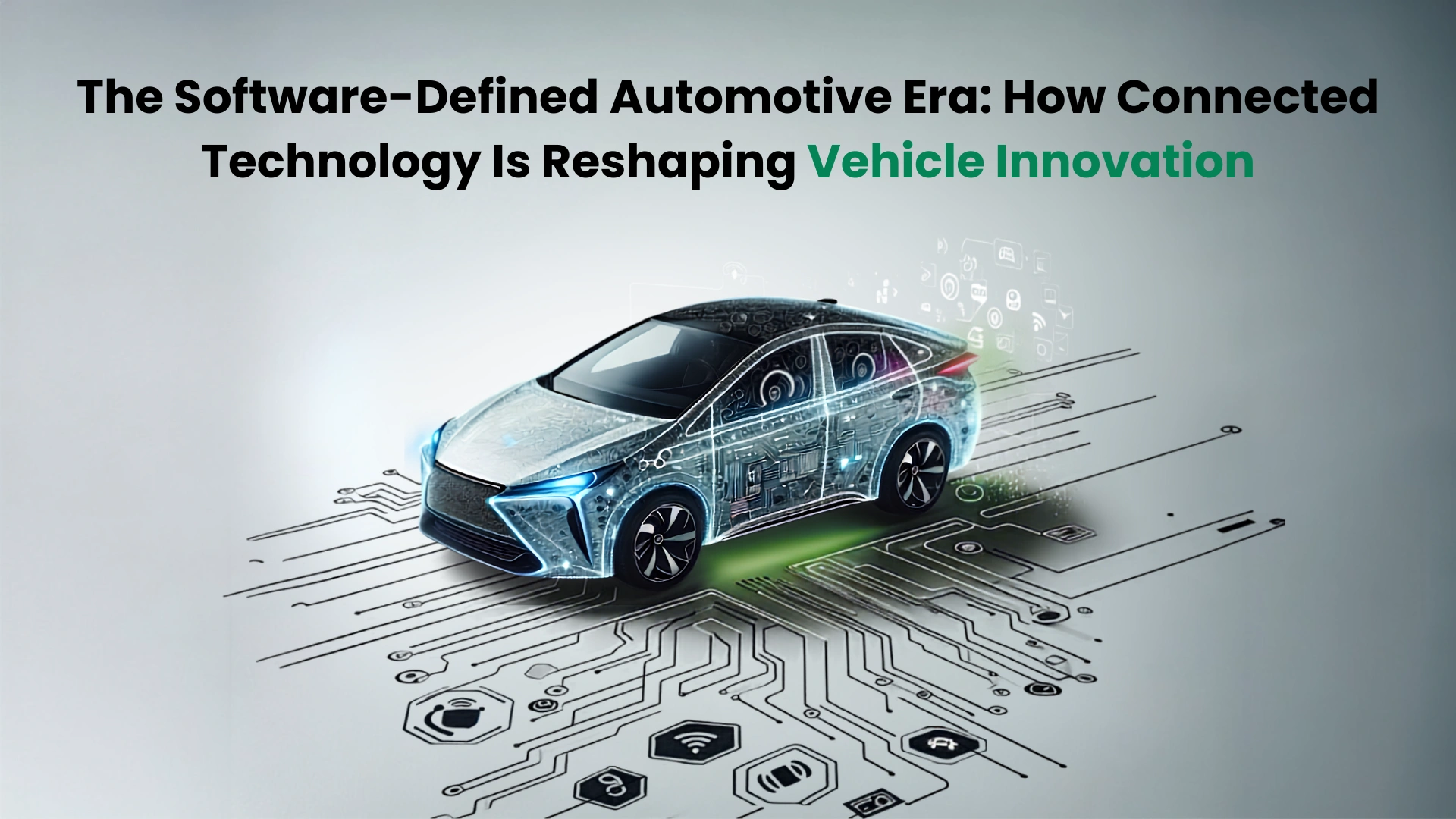
This transition is creating the software-defined vehicle (SDV)—a vehicle where software increasingly determines functionality, performance, personalization, and the ability to introduce new capabilities throughout the vehicle’s lifecycle.
The change is bigger than adding more applications to a dashboard. Automakers are redesigning vehicle architectures so software can interact with sensors, electronic control units, cloud services, driver-assistance systems, and digital platforms.
What Makes a Vehicle Software-Defined?
A conventional vehicle typically has numerous electronic control units performing specific functions.
A software-defined vehicle takes a different approach by centralizing or consolidating computing resources and allowing software to control a wider range of vehicle functions.
The architecture increasingly connects:
Sensors → Vehicle Computing → Software → Connectivity → Cloud → Digital Services
This creates a vehicle that can potentially be updated, monitored, personalized, and enhanced throughout its operating life.
Instead of treating the vehicle as a finished product at the time of delivery, automakers can increasingly treat it as a continuously evolving digital platform.
Over-the-Air Updates Are Changing Vehicle Ownership
One of the clearest examples of software-defined innovation is the expansion of over-the-air (OTA) updates.
Traditionally, improving vehicle software could require a dealership visit.
OTA technology allows manufacturers to deliver certain software improvements remotely.
Updates can potentially improve:
- Infotainment
- Driver assistance
- Battery management
- Energy efficiency
- Connectivity
- User interfaces
- Vehicle features
This changes the relationship between automaker and customer.
The vehicle can continue evolving after purchase rather than remaining largely unchanged until the next service visit or model refresh.
Vehicle Architecture Is Becoming More Centralized
Traditional vehicles can contain dozens or even hundreds of electronic control units.
This creates complexity in software development, communication, maintenance, and upgrades.
Modern SDV architectures are increasingly moving toward domain controllers and centralized computing platforms.
This can simplify hardware while giving software teams greater flexibility.
A more centralized architecture can also make it easier to introduce new software features across multiple vehicle systems.
However, it requires significant engineering changes involving:
- Real-time computing
- Functional safety
- Cybersecurity
- Network architecture
- Software integration
- Hardware abstraction
Connected Cars Are Becoming Data Platforms
Modern vehicles generate enormous amounts of data.
Connected vehicles can produce information about:
- Vehicle health
- Driving behavior
- Battery performance
- Location
- Energy consumption
- Road conditions
- Driver preferences
When appropriately collected and governed, this data can support new services and improve vehicle development.
Automakers can use aggregated vehicle data to identify recurring problems, improve maintenance strategies, understand feature usage, and optimize future vehicle designs.
The vehicle is therefore becoming not just a transportation device, but a connected source of operational and behavioral intelligence.
AI Is Expanding What Vehicles Can Understand
Artificial intelligence is increasingly becoming part of vehicle software.
AI can support:
- Advanced driver assistance
- Driver monitoring
- Voice interfaces
- Predictive maintenance
- Personalization
- Energy optimization
- Traffic prediction
Generative AI is also beginning to influence the in-vehicle experience through more conversational assistants and natural-language interfaces.
Instead of navigating through multiple menus, drivers may increasingly interact with vehicle systems through natural language.
This represents a shift from feature-based interfaces to intent-based interaction.
ADAS Is Becoming More Software-Intensive
Advanced Driver Assistance Systems (ADAS) are among the most software-intensive components of modern vehicles.
Features such as:
- Adaptive cruise control
- Lane-centering
- Automated emergency braking
- Traffic-sign recognition
- Parking assistance
depend on sensors, computing power, perception algorithms, and real-time decision-making.
As these systems become more sophisticated, software development and validation become increasingly important to vehicle safety.
This also means automakers need robust testing environments capable of validating software across millions of possible driving conditions.
Simulation Is Becoming Critical to Vehicle Development
Testing modern vehicle software entirely through physical road testing is increasingly difficult.
Automakers are therefore expanding the use of:
- Digital twins
- Hardware-in-the-loop testing
- Software-in-the-loop testing
- Virtual simulation
- Scenario-based validation
These technologies allow engineering teams to test software against large numbers of driving scenarios before deploying it to vehicles.
This can accelerate development while helping engineers identify edge cases that may be difficult to reproduce in physical testing.
The Vehicle Is Becoming Part of a Larger Digital Ecosystem
A software-defined vehicle does not operate in isolation.
It increasingly connects with:
Vehicle → Smartphone → Cloud → Charging Network → Smart Home → Digital Services
This creates new possibilities for personalized experiences.
For example, a connected vehicle could interact with a driver’s digital calendar, home charging system, navigation preferences, or preferred services.
The result is a broader mobility ecosystem rather than a standalone automobile.
Personalization Is Becoming a Vehicle Feature
Software makes it possible to personalize more aspects of the driving experience.
Depending on the vehicle architecture, personalization could include:
- Seat and mirror settings
- Infotainment preferences
- Navigation
- Driver profiles
- Climate settings
- Interface configuration
- Connected services
Software can potentially allow different users to maintain individualized vehicle environments.
This creates opportunities for automakers to develop stronger customer relationships through digital experiences rather than relying solely on physical vehicle features.
New Revenue Models Are Emerging
Software-defined vehicles are also changing automotive economics.
Automakers can increasingly offer digital features and services through software.
Potential models include:
- Subscription services
- Feature activation
- Connected services
- Premium software packages
- Advanced navigation
- Digital entertainment
- Enhanced driver-assistance capabilities
This creates the possibility of generating revenue throughout the vehicle lifecycle.
However, consumers and regulators are increasingly scrutinizing which vehicle functions should be included as standard features versus offered as paid software services.
Cybersecurity Becomes a Core Vehicle Requirement
Greater connectivity also creates greater cybersecurity exposure.
A connected vehicle can potentially interact with:
- Mobile devices
- Cloud platforms
- Charging infrastructure
- External networks
- Third-party applications
This means cybersecurity must be integrated into vehicle architecture from the beginning.
Modern automotive security strategies increasingly involve:
- Secure software development
- Identity management
- Encryption
- Intrusion detection
- Secure OTA updates
- Vulnerability monitoring
- Continuous security testing
Cybersecurity is no longer simply an IT concern.
It is becoming a fundamental part of vehicle engineering and safety.
Functional Safety and Software Engineering Must Work Together
Automotive software operates in an environment where failures can have physical consequences.
This makes software quality fundamentally different from many consumer applications.
Development teams must account for:
- Functional safety
- Real-time behavior
- Fault tolerance
- System redundancy
- Software validation
- Hardware dependencies
Automakers therefore need engineering processes that combine modern software development practices with established automotive safety standards.
Cloud-to-Car Architecture Is Expanding
The cloud is becoming increasingly important to the connected vehicle.
Cloud platforms can support:
- Fleet analytics
- Vehicle diagnostics
- Software updates
- Data processing
- Customer services
- AI model development
- Predictive maintenance
This creates a continuous feedback loop:
Vehicle Data → Cloud Intelligence → Software Improvement → Vehicle
The more effectively automakers manage this loop, the faster they can identify opportunities to improve the vehicle experience.
Developers Are Becoming Part of the Automotive Ecosystem
The SDV transition is also changing automotive talent requirements.
Automakers increasingly need expertise in:
- Cloud computing
- Embedded software
- Cybersecurity
- AI/ML
- Data engineering
- DevOps
- Simulation
- Distributed systems
This is changing the traditional automotive technology organization.
Software engineers are becoming increasingly central to vehicle development, while mechanical, electrical, and software engineering teams need to collaborate much more closely.
The Biggest Challenge Is Managing Complexity
Software-defined vehicles create significant opportunities, but they also introduce new challenges.
Automakers must manage:
- Software complexity
- Legacy vehicle architectures
- Supplier integration
- Cybersecurity
- Regulatory compliance
- Data privacy
- Software testing
- Long vehicle lifecycles
Unlike smartphones or consumer electronics, vehicles can remain on the road for many years.
Automotive software therefore needs to remain secure, maintainable, and compatible long after the vehicle leaves the factory.
The Future of Vehicle Innovation Is Increasingly Software-Led
The automotive innovation cycle is changing from:
Design → Manufacture → Sell → Service
toward a more continuous model:
Develop → Deploy → Monitor → Update → Learn → Improve
This creates a new relationship between automakers and vehicles.
Manufacturers can potentially learn from vehicle performance, release improvements, introduce new digital capabilities, and personalize experiences throughout the vehicle lifecycle.
Why Software-Defined Vehicles Matter
The software-defined vehicle represents more than a technological upgrade.
It is a change in the fundamental architecture of automotive innovation.
Hardware will remain critical, but software is increasingly becoming the layer that connects vehicle systems, customer experiences, cloud services, AI, and new revenue opportunities.
Automakers that successfully combine software architecture, connected infrastructure, cybersecurity, AI, and strong vehicle engineering will be better positioned to compete in an industry where the definition of a vehicle is expanding beyond its physical components.
The future automobile will increasingly be judged not only by its engine, battery, range, or design—but by how intelligently it can evolve after it reaches the road.